BOSS MAGAZINE>Mark Carney
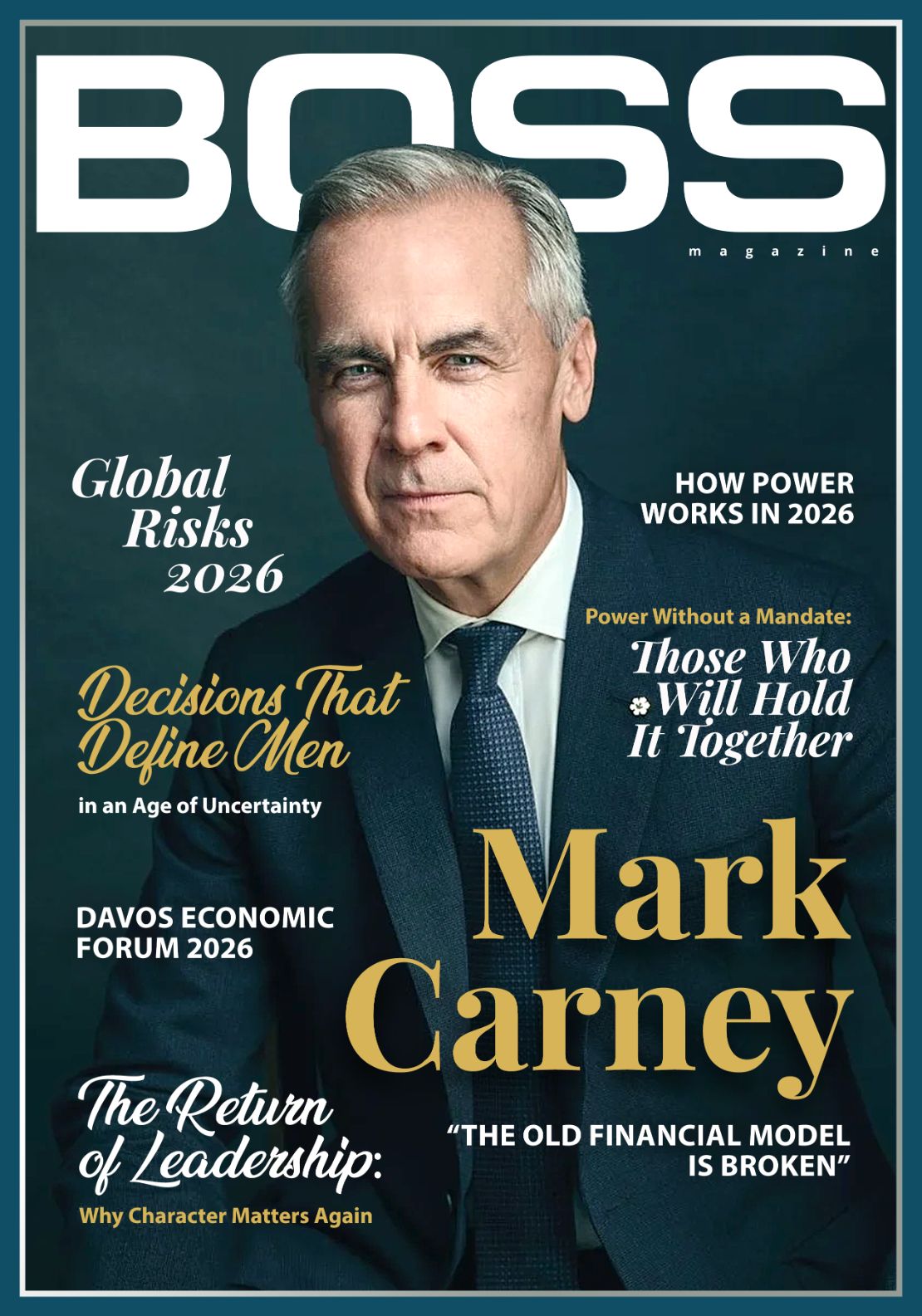
MARK CARNEY
Why Mark Carney became the face of BOSS 2026
Mark Carney was positioned as a defining “boss” figure of the year because he moved from global finance leadership into frontline national and international crisis management—and quickly set a clear agenda around economic resilience, geopolitical repositioning, and state capacity.
Over the past year, he:
Became Canada’s prime minister (March 2025) and immediately restructured government priorities, presenting himself as a technocratic crisis manager able to navigate a volatile relationship with the United States and global markets.
Led Canada’s G7 presidency in 2025, hosting the Leaders’ Summit in Kananaskis and using the platform to frame Canada’s role in collective security and global economic coordination.
Advanced trade and investment diplomacy, including announcing a landmark trade agreement with Indonesia—Canada’s first bilateral deal with an ASEAN country—signaling a diversification and growth strategy.
Made a headline geopolitical argument on the world stage, with a high-profile address at the World Economic Forum that framed the shift away from a rules-based order and urged coordinated action by “middle powers.”
Moved to deepen strategic economic ties with India, part of a broader trade-pivot narrative reported by Reuters.
Over the past year, he:
Became Canada’s prime minister (March 2025) and immediately restructured government priorities, presenting himself as a technocratic crisis manager able to navigate a volatile relationship with the United States and global markets.
Led Canada’s G7 presidency in 2025, hosting the Leaders’ Summit in Kananaskis and using the platform to frame Canada’s role in collective security and global economic coordination.
Advanced trade and investment diplomacy, including announcing a landmark trade agreement with Indonesia—Canada’s first bilateral deal with an ASEAN country—signaling a diversification and growth strategy.
Made a headline geopolitical argument on the world stage, with a high-profile address at the World Economic Forum that framed the shift away from a rules-based order and urged coordinated action by “middle powers.”
Moved to deepen strategic economic ties with India, part of a broader trade-pivot narrative reported by Reuters.
Key talking points from Carney’s WEF Davos 2026 speech
“Rupture, not transition”: the old global order is breaking.
He argues the world is experiencing a rupture—a sharp break—rather than a gradual shift, with geopolitics increasingly driven by unconstrained great-power rivalry.
The “rules-based international order” is fading—and pretending otherwise is dangerous.
He says leaders should stop treating the rules-based order as if it still reliably governs behaviour, because institutions and norms are being applied unevenly and are under direct pressure.
Middle powers aren’t powerless—but they must act together.
A central message: countries like Canada can build leverage only through coordination, not by negotiating alone. He uses the idea that if you’re not at the table, you’re on the menu to stress collective action.
Strategic autonomy matters, but a “world of fortresses” is a losing outcome.
He acknowledges the pull toward self-reliance (supply chains, security, industrial capacity), but warns that pure defensive fragmentation would make the world poorer, more fragile, and less sustainable.
“Variable geometry”: coalitions by issue, not one-size-fits-all alliances.
He proposes flexible, issue-based coalitions—different groups for different problems—grounded in shared interests and values.
Values as the foundation of a new order.
He frames the alternative order around principles like human rights, sovereignty, territorial integrity, solidarity, and sustainable development—arguing these can’t be optional if middle powers want legitimacy and durability.
Build strength at home to reduce leverage held by great powers.
He links foreign-policy independence to domestic economics: removing internal trade barriers, investing in infrastructure, improving competitiveness, and diversifying trade relationships so that no single power can dominate your options.
Stay committed to collective security while adapting.
He reaffirms commitments to alliances like NATO, while arguing adaptation is unavoidable in the new environment.
He argues the world is experiencing a rupture—a sharp break—rather than a gradual shift, with geopolitics increasingly driven by unconstrained great-power rivalry.
The “rules-based international order” is fading—and pretending otherwise is dangerous.
He says leaders should stop treating the rules-based order as if it still reliably governs behaviour, because institutions and norms are being applied unevenly and are under direct pressure.
Middle powers aren’t powerless—but they must act together.
A central message: countries like Canada can build leverage only through coordination, not by negotiating alone. He uses the idea that if you’re not at the table, you’re on the menu to stress collective action.
Strategic autonomy matters, but a “world of fortresses” is a losing outcome.
He acknowledges the pull toward self-reliance (supply chains, security, industrial capacity), but warns that pure defensive fragmentation would make the world poorer, more fragile, and less sustainable.
“Variable geometry”: coalitions by issue, not one-size-fits-all alliances.
He proposes flexible, issue-based coalitions—different groups for different problems—grounded in shared interests and values.
Values as the foundation of a new order.
He frames the alternative order around principles like human rights, sovereignty, territorial integrity, solidarity, and sustainable development—arguing these can’t be optional if middle powers want legitimacy and durability.
Build strength at home to reduce leverage held by great powers.
He links foreign-policy independence to domestic economics: removing internal trade barriers, investing in infrastructure, improving competitiveness, and diversifying trade relationships so that no single power can dominate your options.
Stay committed to collective security while adapting.
He reaffirms commitments to alliances like NATO, while arguing adaptation is unavoidable in the new environment.